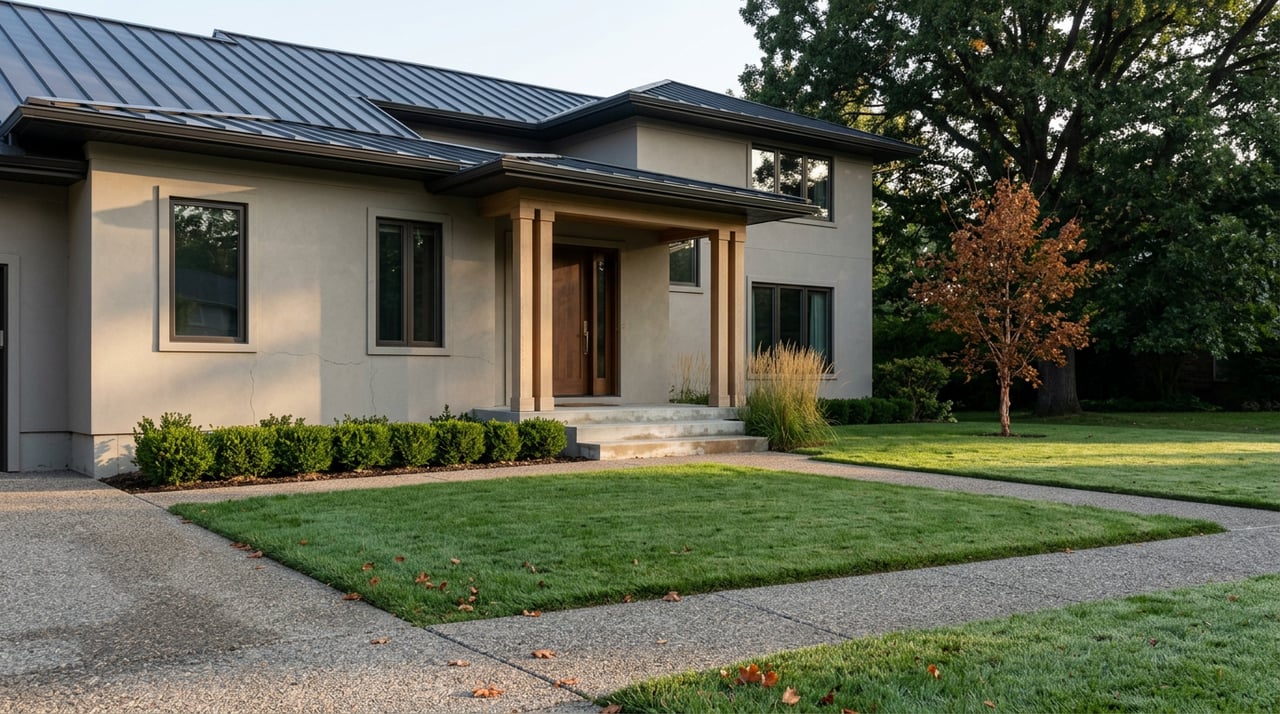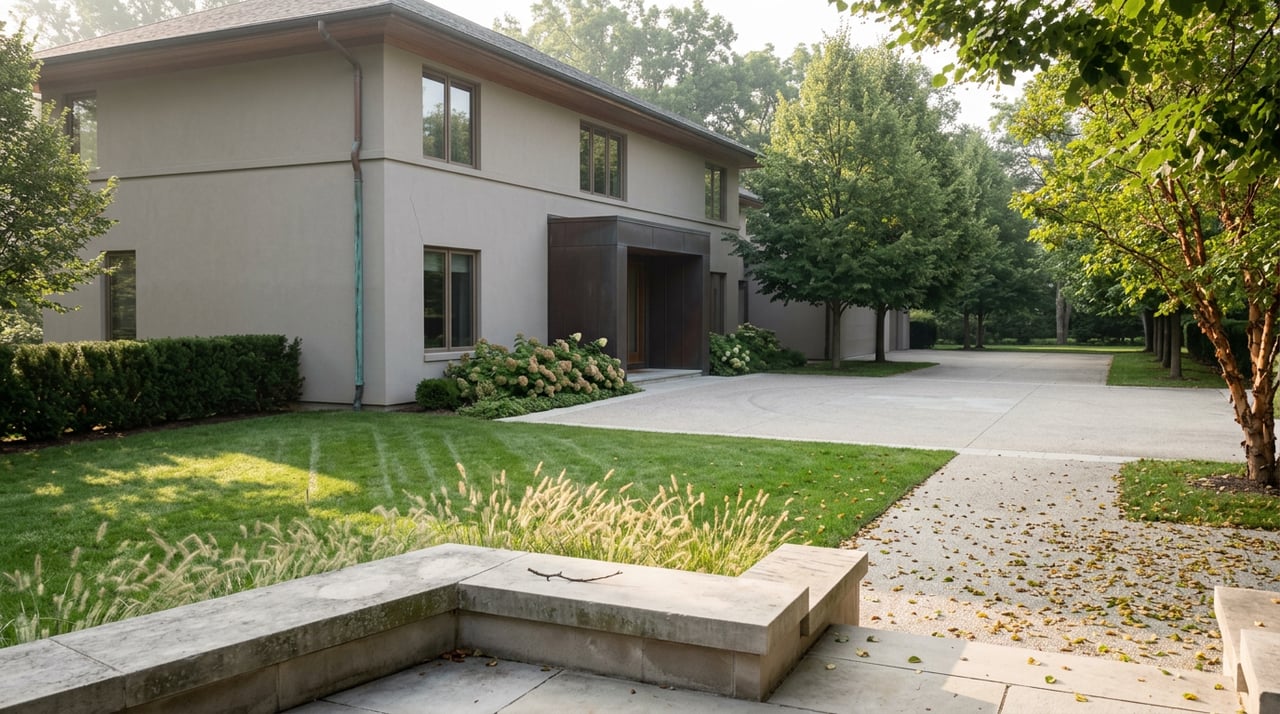
Most people who walk the paved trail out of the York Mills Arena parking lot turn around at the same spot. They follow Wilket Creek past the Banbury Community Centre, cross the open meadow where kids toboggan in January, and stop where the trees thicken into a wall of green. It reads like the edge of the park. It isn't. Keep walking and the trail spills onto the driveway of a grey limestone estate house built for a man who once bred the most famous racehorse Canada has produced, on this exact ground.
If you have lived near Windfields Park for any length of time and never crossed that treeline, you are not alone. The property on the other side does not look like public land, because for most of its history it wasn't quite one thing or the other. Understanding why takes a short detour into how this park actually came to be, which is really the story of one farm split by paperwork instead of a fence.
One Farm, Two Deeds
The land under Windfields Park and the Canadian Film Centre next door used to be a single holding. Edward Plunket Taylor, known around Toronto simply as E.P. Taylor, bought the 20-acre parcel in 1932 and had the main house built in 1936, a Georgian Revival building of grey Wiarton limestone set 300 yards back from Bayview Avenue behind a circular drive. His wife, Winnifred, is said to have named the property Windfields while walking the open fields on a breezy day, and the name stuck to more than just the house. Taylor's breeding operation, known as Windfields Farm, eventually stretched across parcels on both sides of York Mills Road and along Bayview Avenue, a scale of land ownership that is hard to picture now that most of it is subdivided into the streets around Post Road and Banbury.
The split happened in two stages, which is why the boundary on the ground still feels blurry. In the late 1960s, Taylor carved out roughly 50 acres and handed it to the Borough of North York for parkland, keeping the house and its immediate grounds for the family to live in. That gift became Windfields Park, close to 80 acres today once you count later additions. The house itself stayed private for another two decades. The Taylor family lived there until 1987, when the remaining estate was formally transferred to the city. The following year, filmmaker Norman Jewison founded what is now the Canadian Film Centre on the site, leasing the grounds from the city and opening them, gradually, back up to the public.
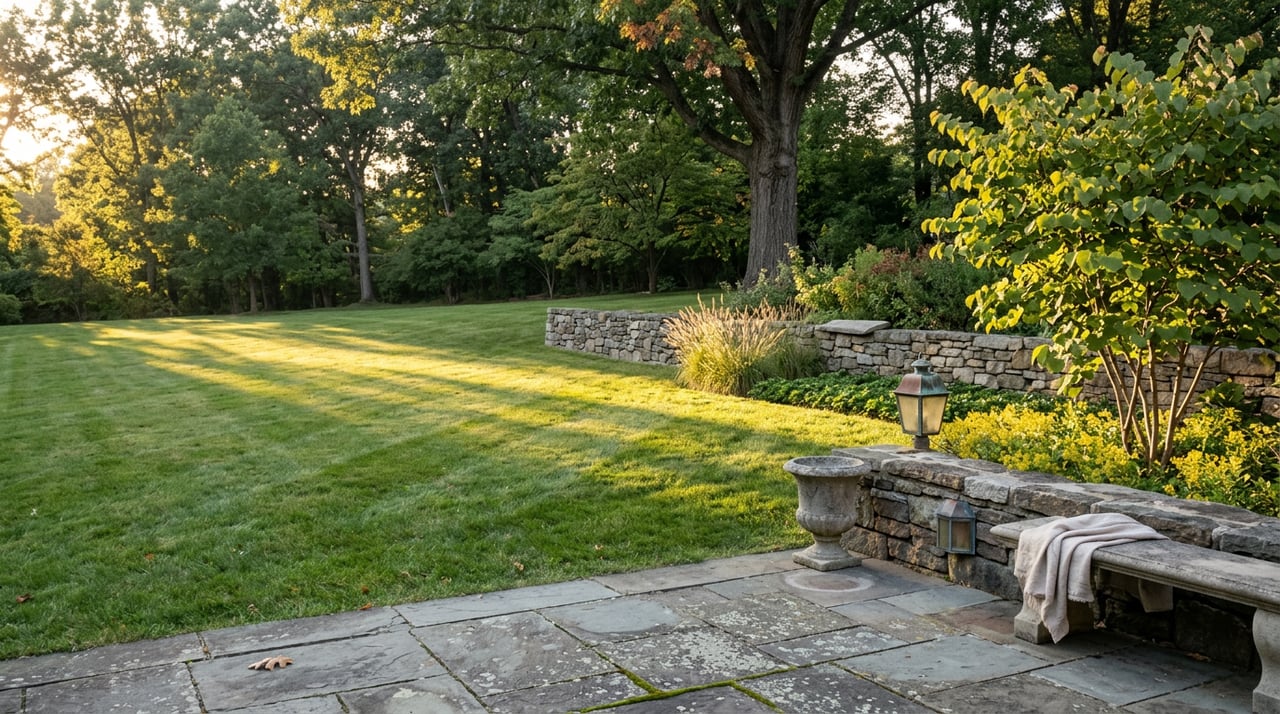
Northern Dancer, the horse most people in this neighbourhood have at least heard of, was not actually foaled here. He was born in 1961 on the Taylors' larger breeding farm in Oshawa and went on to win the 1964 Kentucky Derby, the first Canadian-bred horse to do it. But the York Mills property carries his name anyway, most visibly in the Northern Dancer Pavilion, a newer building on the film centre grounds constructed over the footprint of the family's old swimming pool. The orchard nearby still has apple trees estimated at more than a century old, several of them replanted after the 2013 ice storm took out the originals. The film centre's groundskeepers have also planted cherry trees along the Bayview Avenue frontage over the years, mostly for the benefit of people driving past who have no idea what is behind the tree line.
The Loop
None of this requires an invitation. The film centre grounds are open to walkers, and the connecting trail through the park makes the whole thing a single continuous route rather than two separate destinations you'd need to plan around.
- Park at York Mills Arena, at the southeast corner of Bayview Avenue and York Mills Road, or at the Banbury Community Centre lot on Banbury Road.
- Pick up the paved trail and follow Wilket Creek north through the park's forested section, watching for red oaks and, depending on the season, a fair number of cardinals and woodpeckers along the water.
- Pass the Banbury Community Centre and its tennis club, then continue through the open meadow, which still has the rolling shape of old farmland underneath the grass.
- Where the trees close in again, keep going. There is no gate and no sign warning you off. You'll come out on the film centre's grounds, with the Main House on one side and the Northern Dancer Pavilion and orchard on the other.
- Loop back the way you came, or exit onto Bayview Avenue near the stone gateposts if you'd rather finish the walk on pavement.
The full circuit, arena to estate house and back, runs close to five kilometers, an easy walk if you don't stop. Almost nobody does it in under an hour, because there is always a reason to slow down, whether that's the birds along the creek or the strange feeling of standing on a private estate that belongs, in practice, to everyone.
What's Within Ten Minutes
The park is the anchor, but it sits inside a small cluster of landmarks that most residents drive past without registering, mostly because none of them are marked from the road in any obvious way.
On Don Ridge Drive sits St. John's Anglican Church, built in 1843 and 1844 and designed by John George Howard, one of the oldest buildings still standing in North York. A steep stone staircase climbs to it from Yonge Street, and the cemetery beside the church holds the graves of hockey player Lionel Conacher and artist C.W. Jefferys. Jefferys' own home, a circa-1833 house at 4111 Yonge Street built by Rowland Burr and later used as a church parsonage, sits a short walk away. Jefferys lived there from 1922 until 1951 while teaching drawing and painting at the University of Toronto, and the house was physically moved back from the road in 1956 when Yonge Street was widened.
A few minutes east on Moatfield Drive is the Duncan Gingerbread Farmhouse, built around 1865 by dairy farmer David Duncan, who was the first person to bring Jersey cows to Ontario. It's one of the last surviving examples of Gothic gingerbread architecture in the province and was relocated to its current site in 1986. Closer to Leslie Street, Kirkwood Park offers four lit tennis courts if you'd rather play than walk, and the corner of Leslie and Coldwater has a public art piece by Gosia Komorski, an artbox designed as a patchwork of the surrounding area's history, referencing everything from West Highland Creek to the old Huron-Wendat village site to the neighbourhood's own bungalow streets. Owen Park, a smaller green space off Gordon Road, rounds out the list if you're walking with kids who need a playground stop before the drive home.
The Table at the End
If the walk leaves you hungry, there's one obvious place to finish it. Windfield's Restaurant, on York Mills Road, has been open under that name since 1994 and still runs as a family place, with a horse-themed dining room, a patio that opens once the weather turns, and a menu built around the kind of breakfast plates and comfort food you'd expect from a spot that has outlasted several waves of new development around it. Whether the name was chosen on purpose or landed on independently, the restaurant has carried the same word as the horse farm down the road for more than three decades, a small coincidence that most regulars have never thought twice about.
That's the thing about this stretch of North York. The history isn't hidden exactly. It's just unmarked, split between a park sign that stops mentioning the estate and an estate that doesn't advertise the park. Walk the whole loop once and you start noticing the name everywhere, on the pavilion, on the restaurant menu, in the shape of a meadow that used to be a horse farm. It's the kind of detail you only pick up by actually walking it, which is reason enough to do it again this weekend.
If you're already calling St. Andrew-Windfields home and want to talk through what a property here is actually worth, or you're weighing a move into the area and want someone who knows it past the surface, Bryan Wong-Lim is glad to talk it through. Let's Connect.