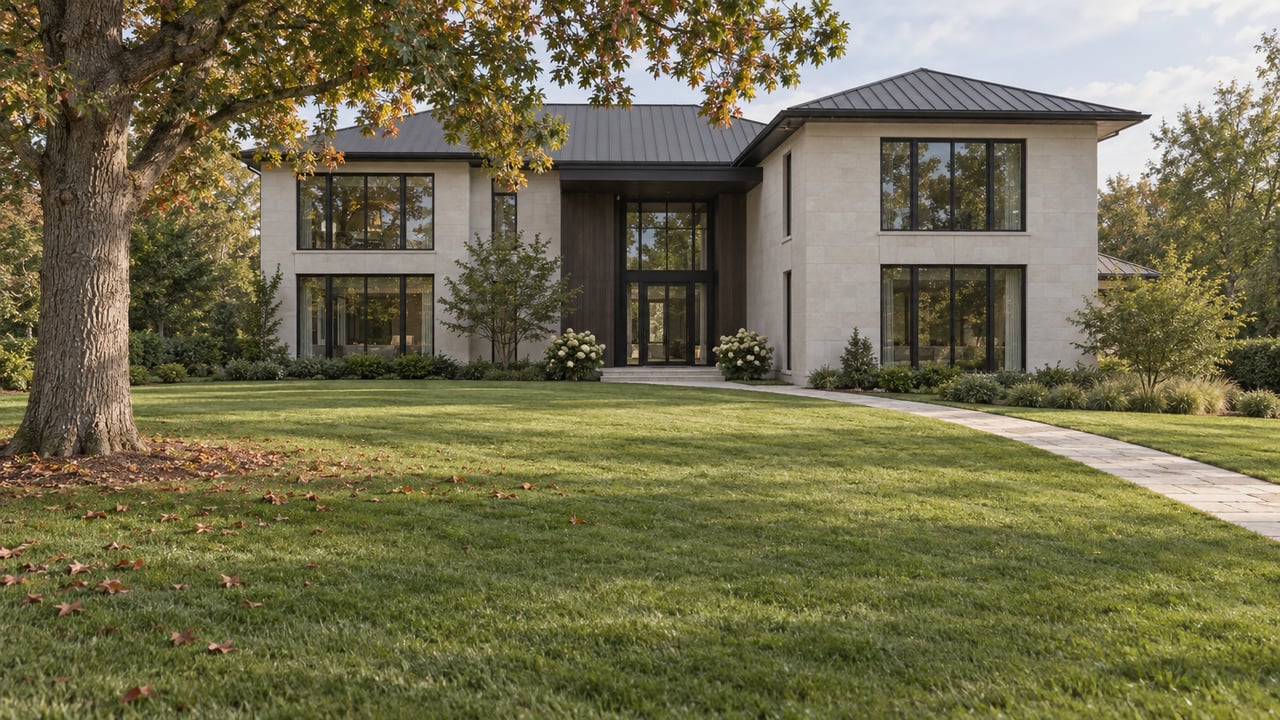
A recent lot-size map published by the civic newsletter Toronto City Hall Watcher color-codes every residential zone in the city by its minimum lot size. Across most of Scarborough, North York, and Etobicoke, that number sits between 300 and 600 square metres, small enough that a single wide lot can often be split into two. Then there is one shaded patch north of Sunnybrook that breaks the pattern entirely: a minimum lot size of 8,000 square metres, roughly twenty times the citywide norm. That patch is the Bridle Path.
The gap matters more than it looks. Toronto has spent the past few years making it easier to add density to existing lots, through as-of-right multiplex construction and more permissive lot severance under the city's Expanding Housing Options in Neighbourhoods policy. Streets that once held a single house now sometimes hold two, three, or four units on the same footprint. None of that machinery can reach the Bridle Path, because the zoning floor there was set decades before any of these reforms existed, and it has never moved. If you are comparing Toronto's most expensive enclaves and trying to work out which ones carry real subdivision upside and which ones don't, this is the number that answers the question.
Where the citywide reform actually applies
Severance in Toronto runs through a specific legal track. Splitting one lot into two requires a consent under Section 53 of the Ontario Planning Act, decided by the city's Committee of Adjustment rather than issued as a building permit. A lot qualifies when its frontage and area, on paper or after a minor variance, meet the zoning by-law minimum for that zone, and when the resulting lots match the pattern already established on the street.
That second condition is where local precedent does most of the work. A North York case makes the point concretely. A lot on Woburn Avenue, zoned R6(20) and just over 12 metres wide, was severed into two lots of about 6.1 metres frontage each, roughly half the applicable minimum. The Ontario Municipal Board approved it anyway, because the applicant's planner produced evidence of 45 nearby properties already sitting on similarly narrow frontages, and the city's own lot-pattern study confirmed that most surrounding lots already fell under the standard minimum. In a neighbourhood with a mixed grain of lot sizes, a below-minimum severance has company to point to.
This is also the logic behind Toronto's broader multiplex and severance push. Toronto's Zoning By-law 569-2013 sets baseline minimums for frontage and area, but those figures shift by zone category and by site-specific exception, and across most of Scarborough, North York, and Etobicoke they land low enough that severance is described as feasible for the majority of residential lots in the city.
The number that was never designed to move
The Bridle Path's 8,000-square-metre minimum is not an oversight in that same by-law. It is a site-specific holdover from how the neighbourhood was built. In the late 1940s, George Montegu Black Jr., father of Conrad Black, took control of the company that owned the farmland that would become the Bridle Path and set restrictions through the North York zoning by-law limiting the land to single-family dwellings on lots of at least two acres. The area was carved into roughly fifty lots, each originally selling for about $25,000. Every home in the neighbourhood today, on lots running from two to four acres, sits inside boundaries drawn by that decision.
That is the opposite of the Woburn Avenue situation. A Committee of Adjustment weighing a request to sever a Bridle Path lot would have no comparable neighbouring precedent to point to, because the entire street was built to the same oversized standard from the start. There is no cluster of smaller lots nearby to argue the character of the area already supports subdivision, because the character of the area is uniformity at scale. The same process that makes severance routine on a mixed-lot North York street makes it close to unarguable on the Bridle Path.
What that means next to Lawrence Park, Forest Hill, and Rosedale
This is where the zoning detail turns into a market signal. In neighbourhoods where severance and infill are live options, land value tends to track what a lot could become as much as what currently sits on it. Lawrence Park has led comparable Toronto neighbourhoods in median sold price, sitting around 5 million dollars in 2025, on the strength of a larger stock of family-sized detached homes that can turn over and, in some cases, be reconfigured. Forest Hill and Rosedale have held medians above 3 million dollars over the same period, markets shaped by steady transaction volume and a mix of lot sizes.
The Bridle Path doesn't compete on volume or median. Average sold prices on its most prominent streets, Park Lane Circle, High Point Road, and The Bridle Path itself, were reported around 11.5 million dollars in late 2025, with individual transactions on Park Lane Circle in the 25 to 30 million dollar range during the same period. A French Revival estate at 15 High Point Road was listed for 49.95 million dollars in 2025, among the most expensive listings in the city at the time. What sets these numbers apart from Lawrence Park or Forest Hill isn't just size, it's that a Bridle Path lot's value has nowhere else to go. It cannot be split, stacked, or infilled the way a comparably priced lot elsewhere in the city increasingly can. The scarcity is structural rather than a function of current demand, which is a different kind of asset than a large detached home on a lot that could, under the right application, become two.
The process still exists, it just runs into a wall
None of this means the Committee of Adjustment process is irrelevant to Bridle Path ownership. An unsuccessful applicant, or a neighbour who objects to any proposal, has 20 days to appeal under the Planning Act, and inside Toronto that appeal goes to the Toronto Local Appeal Body rather than the Ontario Land Tribunal that hears equivalent appeals everywhere else in the province, a distinction that trips up generic provincial guides. A full application also carries a survey, a planning justification report, and Committee of Adjustment fees that reset every January 1 under the Toronto Municipal Code.
What's different on the Bridle Path is what an applicant would be asking the Committee to approve. A minor variance to reduce lot area from 8,000 square metres to something smaller isn't a modest ask on the margins of an existing standard, it's a request to abandon the defining feature of the street. The same fee schedule and hearing process apply, but the outcome the process is built to protect, in this specific zone, is the absence of subdivision rather than its approval.
What this means if you're comparing the neighbourhoods
If you're weighing the Bridle Path against Lawrence Park, Forest Hill, or Rosedale as part of a longer-term hold, the zoning floor is the detail that should shape how you think about upside. In those other neighbourhoods, a wide lot sometimes carries latent value as a future severance or multiplex site, and Toronto's recent policy changes have made that latent value more real than it was five years ago. On the Bridle Path, that lever doesn't exist. The value case for land there rests entirely on the fact that no more of it will ever be created within the boundary, and that the zoning by-law that drew those boundaries in the 1940s has no active process moving toward it.
FAQ
Could the city lower the Bridle Path's minimum lot size in a future zoning update? Site-specific zoning exceptions like this one are set individually and haven't moved as the citywide by-law has been amended around them. There's no current application or proposal in the record that would change the 8,000-square-metre figure for the neighbourhood.
Does this affect the low-rise condominium buildings inside the Bridle Path, like One Post Road? No. The minimum lot size restriction applies to the single-family estate lots the neighbourhood is known for. Buildings like One Post Road were developed under separate approvals and don't change the severance picture for the surrounding estate streets.
Is a lot this size ever going to be worth more split than whole? Not under the current by-law. Because severance isn't a realistic path here, land value on the Bridle Path is priced as a complete estate lot rather than as a future multi-lot site, which is a different calculation than the one buyers are increasingly running in neighbourhoods where subdivision has become routine.
If you're weighing a Bridle Path estate against a comparable lot elsewhere in Toronto and want a clear read on which one actually carries future upside, Bryan Lim can walk through what the zoning on each address actually allows before you make an offer.
This article is general information, not legal, tax or financial advice. Consult a qualified professional about your situation.